The journey of a Venetian publisher
Active between approximately 1757 and 1797, Antonio Zatta (born around 1722 and died in 1804 or 1797 depending on sources) ran a prolific publishing house in Venice. Before dedicating himself fully to cartography, he worked for the Society of Jesus until 1773 and published various works, ranging from architectural studies on St. Mark's Basilica (1761) to musical scores by composers like Luigi Boccherini. From 1780 onwards, he collaborated closely with his sons under the name "Antonio Zatta e figli," with his son Giovanni Zatta likely succeeding him from 1796.
The Atlante Novissimo: a monumental work
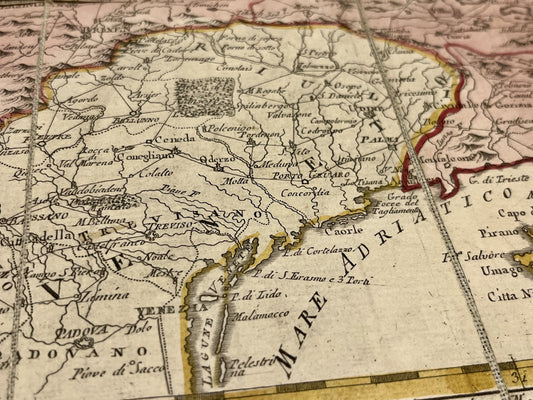
Antonio Zatta's masterpiece is undoubtedly the Atlante Novissimo, published in four volumes between 1775 and 1785 (or 1789). This universal atlas, containing approximately 240 maps, is one of the most comprehensive and aesthetically pleasing published in Italy at that time. The atlas is distinguished by its inclusion of the most recent discoveries, notably Captain James Cook's explorations in the Pacific. Zatta's maps are renowned for their illustrated cartouches and characteristic decorative borders that aid in their identification.
Contributions to the cartography of America and collaborations
Antonio Zatta made a notable contribution to the geographical knowledge of the New World. In 1778, he published a series of 12 maps of the united colonies of North America ("Colonie Unite"), integrated into Abbé Raynal's work Storia dell' America Settentrionale. His works benefited from collaborations with renowned engravers and artists such as Giuliano Zuliani, Giovanni Marco Pitteri, and Pietro Antonio Novelli. Beyond world maps, he also produced an extensive collection of topographical maps of Italian provinces and Eastern European regions.