Professor at the Royal Military Academy
Born in Paris on October 11, 1730, Edme Mentelle first studied at the Collège de Beauvais under the direction of Jean-Baptiste-Louis Crevier. After a stint in the administration of the tax farms and a few literary endeavors, he devoted himself to the study of geography. He began publishing his works in 1758 with Elements of geography.
In 1760, he was appointed professor of geography and history at the Royal Military School, a position he held until 1792. During this period, his students included the young Napoleon Bonaparte. A member of the Academy of Rouen from 1768, he also held the title of historiographer to the Count of Artois and served as royal censor.
The globe for the Dauphin and cartographic innovations
In 1786, Edme Mentelle, with Jean Tobie Mercklein, created a masterpiece of precision for the education of Louis XVI's eldest son: a composite or "nested" globe 1.30 m in diameter. This unique globe had an outer terrestrial face, an inner celestial face, and, inside, a sphere depicting the seabed and continental landforms according to naval data.
His written work is considerable and includes:
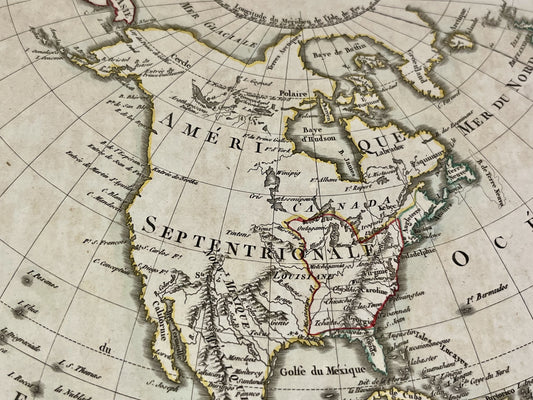
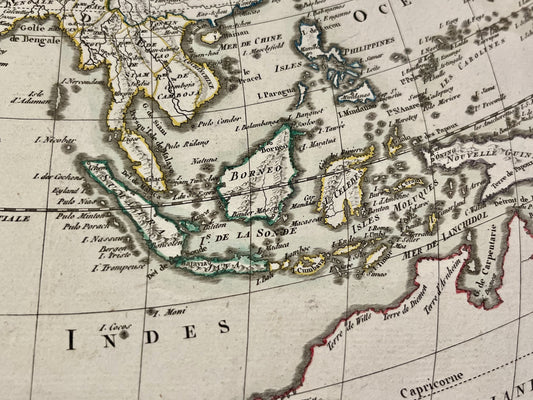
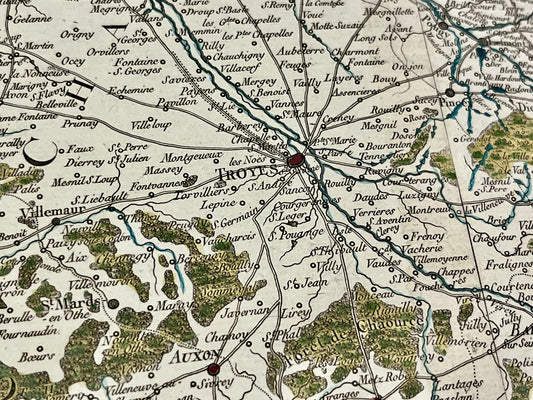
- L'Universal Atlas (1779), consisting of 170 cards.
- ThereComparative Geography (1778).
- The Complete course in cosmography, chronology, geography, and history (1801).
- The volumes of the Ancient Geography for the Encyclopédie méthodique.
- The Map of the West Indies (1795), in collaboration with Pierre-Gilles Chanlaire.
A committed witness to the Revolution
A supporter of new ideas, Mentelle was closely linked to Jacques Pierre Brissot and Madame Roland. During the Terror, he remained loyal to his friends, visiting Brissot in prison and receiving the manuscript of Madame Roland's Memoirs under the code name "Jany".
He continued his career under the Republic and the Empire, teaching at the Central Schools and the École Normale. Elected a member of the National Institute of Sciences and Arts in 1795, he participated in its founding. A Knight of the Legion of Honour in 1814, he died in Paris on December 28 or 29, 1815 (some sources cite April 1816) and is buried in Père-Lachaise Cemetery