An engineer and man-at-arms in the service of the crown
Jean de Lucmau de Classun, also known as the Lord of Classun, was born on October 6, 1598, at the Château de Classun, where he died on May 10, 1653. A man of many talents, he pursued both a military career as a sergeant-major in the Miossens regiment and a technical career as a royal engineer. His dual expertise allowed him to contribute to defense matters, notably in 1650 when the aldermen of Dax consulted him to assess the repairs and fortifications necessary to make the town defensible.
Pioneer of regional and ecclesiastical mapping
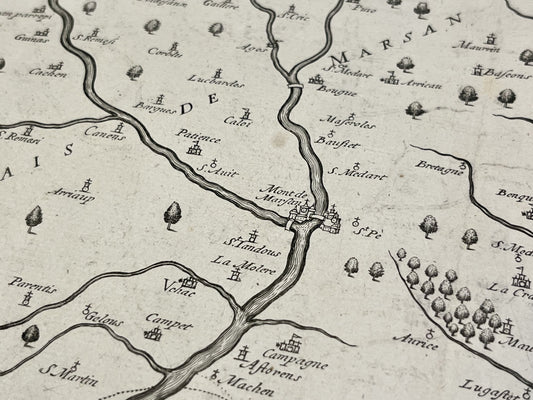
Considered one of the first provincial geographers to have fostered the development of French cartography, Sieur de Classun distinguished himself through works of great historical value. In 1635, he produced the oldest known map of the diocese of Aire at the request of Bishop Gilles Boutault, published in Paris by the engraver Jean Boisseau. In 1638, he published a detailed map of the presidial court of Dax and the seneschal's court of Lannes, including the courts of Bayonne, Saint-Sever, and Tartas, as well as a plan of the city of Dax showing its principal monuments.
Military works and mapping of Guyenne
Jean de Lucmau de Classun's work was also sought after by high-ranking military leaders. In 1638, Marshal of France Frédéric-Armand de Schomberg commissioned him to create an accurate map of all the towns and villages of Guyenne. Although some of his work has not survived, his "Plan of the City and Citadel of Perpignan," completed in 1645 and dedicated to the Marshal, testifies to his precision in depicting the lines of circumvallation and the state of the royal armies. Alongside his geographical work, he wrote genealogical memoirs, demonstrating his deep interest in the history and nobility of his province.