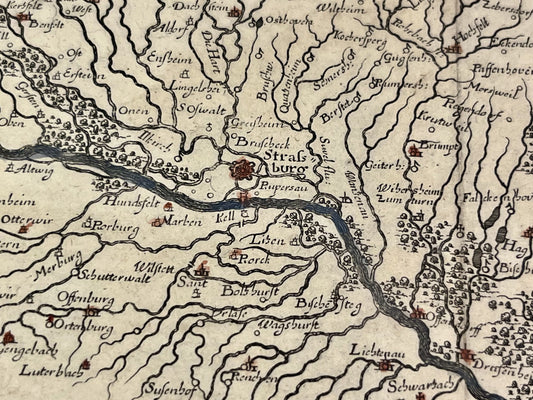
A master of European engraving
Born in Basel on September 22, 1593, Matthäus Merian trained in copperplate engraving in Zurich, then traveled throughout Europe, staying in Strasbourg, Nancy, and Paris. In 1616, he settled in Frankfurt am Main where he worked for the publisher Johann Theodor de Bry, whose daughter, Maria Magdalena, he married in 1617.
After his stepfather's death in 1623, he took over the management of the publishing house. In 1626, he acquired citizenship in Frankfurt, which allowed him to become an independent publisher. He was the father of Matthäus Merian the Younger and the renowned naturalist and illustrator Maria Sibylla Merian.
The monumental work: the Topographia Germaniae
Merian's most famous project is the Topographia Germaniae, a monumental series whose publication began in 1642. For this work, he collaborated with the geographer Martin Zeiler (1589-1661), who wrote the texts. This collection consists of:
- 16 volumes published during his lifetime, totaling 30 volumes for the complete series.
- More than 2,000 engravings of remarkable precision.
- Numerous panoramic views of cities, plans and maps.
This work remains one of the most important examples of topographical illustration of the period, appreciated for its finesse and technical accuracy.
Historical chronicles and illustrations
In addition to his geographical work, Merian directed and illustrated several major publications that marked the publishing landscape of the 17th century:
- TheTheatrum Europaeum, a chronicle of contemporary events and European wars.
- The Gallia Orientalis.
- The illustration of the Bible (1625-1630), known as Merian Bible.
- The pursuit of Grand and Short Journeys initiated by the De Bry family.
Matthäus Merian died on June 19, 1650 in Bad Schwalbach, near Wiesbaden, after several years of illness. His business was continued by his sons, Matthäus the Younger and Caspar, ensuring the dissemination of his work for several decades.