A master of engraving between Mechelen, Antwerp and Cologne
Frans Hogenberg, born in Mechelen around 1535 and died in Cologne in 1590, came from a family of artists. The son of engraver Nicolaas Hogenberg, he had to leave the Netherlands for religious reasons and settled in Cologne around 1570 after stays in Antwerp and London. His exceptional talent for copperplate engraving placed him at the heart of the major publishing projects of his time. He was notably the principal engraver of maps for theTheatrum Orbis Terrarumd Abraham Ortelius (1570), the first modern atlas, of which he produced almost all of the original plates.
The co-creator of the Civitates Orbis Terrarum
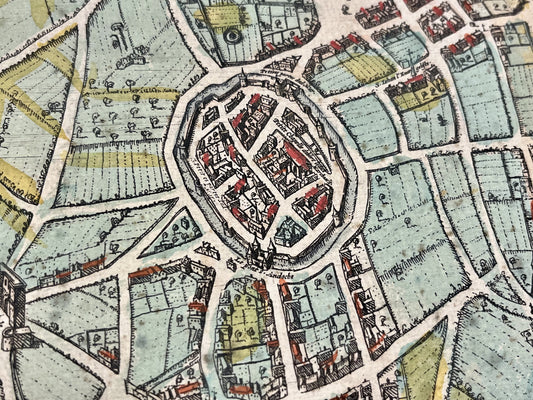
Hogenberg's major contribution to urban geography lies in his collaboration with Georg Braun for the Civitates Orbis Terrarum. For this monumental work, he did more than simply direct the engraving workshop; he developed a remarkably precise style of bird's-eye views, allowing cities to be visualized in their three-dimensionality. His work on this atlas, which required the creation of hundreds of plates, made it possible to document the state of the world's cities with unprecedented detail, blending topography and architectural features.
A pioneer in topical engraving and illustrated press
Beyond pure cartography, Frans Hogenberg invented a new genre: the "news engraving." He produced vast series of prints illustrating the significant events of his time, notably battle scenes, sieges, and executions during the Wars of Religion and the Revolt of the Beggars. These plates, often accompanied by explanatory commentaries, constitute the precursors of modern photojournalism. His legacy is immense, not only for the quality of his line work, but also for his ability to transform maps and images into tools for information and historical memory.