A multifaceted humanist in Périgord
Jean Tarde, born in 1561 or 1562 in La Roque-Gageac and died in 1636, led a remarkable ecclesiastical and scientific career. A Doctor of Law from the University of Cahors, he became a canon theologian and penitentiary of Sarlat Cathedral. During his travels to Rome, he met Galileo in 1614, who gave him one of his first astronomical telescopes. This encounter profoundly influenced his work, leading him to observe sunspots and publish astronomical works such as "Les Astres de Bourbon" in 1620, in which he dedicated his discoveries to King Louis XIII.
Cartographic excellence and description of the diocese
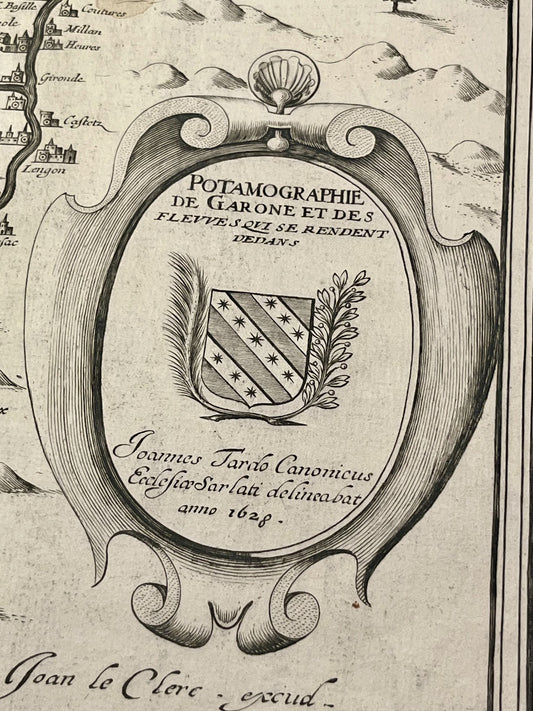
As the king's ordinary geographer, Jean Tarde produced cartographic works of great precision for his time. His most famous achievement is the map of the diocese of Sarlat, entitled "Sarlatensis Dioecesis," engraved by Jean de la Haize. This map, later incorporated into the atlases of Jean Boisseau and Nicolas Sanson, is distinguished by the richness of its topographical details. He also authored a map of the diocese of Périgueux, thus contributing decisively to the geographical knowledge of the province of Guyenne.
A historian and chronicler of his time
Beyond his maps, Jean Tarde left a valuable written legacy for regional history. His work "Les Chroniques de Jean Tarde," completed around 1624, constitutes a major source on the history of the diocese of Sarlat, covering a period from its origins to the reign of Louis XIII. In it, he notably recounts the ravages of the Wars of Religion in Périgord. His approach, combining scientific observations, geographical surveys, and historical research, makes him one of the greatest French scholars of the late Renaissance.