Matthäus Seutter and the influence of the Augsburg school
Matthäus Seutter (1678-1757) began his training with Johann Baptist Homann in Nuremberg before establishing his own business in Augsburg. Under his leadership, the city became a major center of German cartography, rivalling the output of his former master. His success and the quality of his work earned him the prestigious title of Imperial Geographer, bestowed by Emperor Charles VI in 1732, a distinction he proudly displayed on his works.
Diverse and artistic production
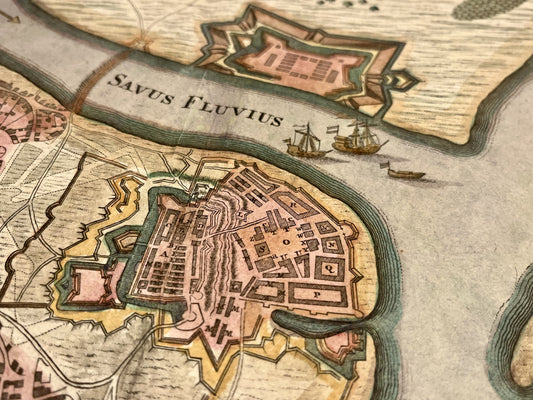
Throughout his career, Seutter produced a monumental body of work comprising approximately 500 maps and several atlases. His publications cover a wide variety of subjects, ranging from geographical maps of countries and regions to highly detailed city plans. He also distinguished himself by creating original thematic maps, dealing with subjects such as love or drunkenness, thus illustrating the diversity of his catalogue and his adaptation to the expectations of the time.
A baroque style with meticulous finishes
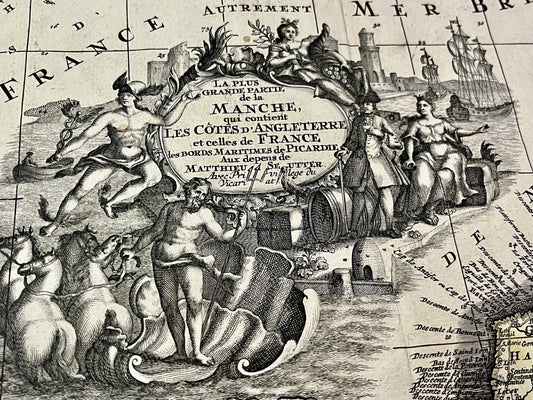
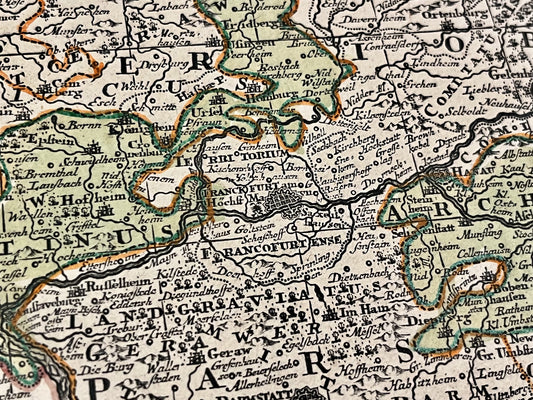
Seutter's maps are characterized by a strong baroque aesthetic, particularly through richly decorated and detailed title cartouches. His copper engravings, often complemented by vibrant hand-coloring, are sought after for their visual quality as much as for their historical value. After his death in 1757, his cartographic legacy was continued by his son Albrecht Carl and his son-in-law Tobias Conrad Lotter.