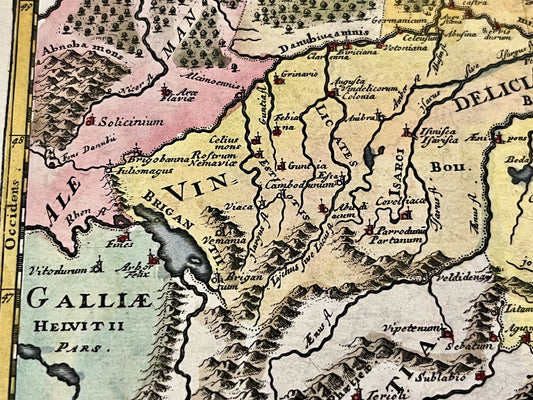
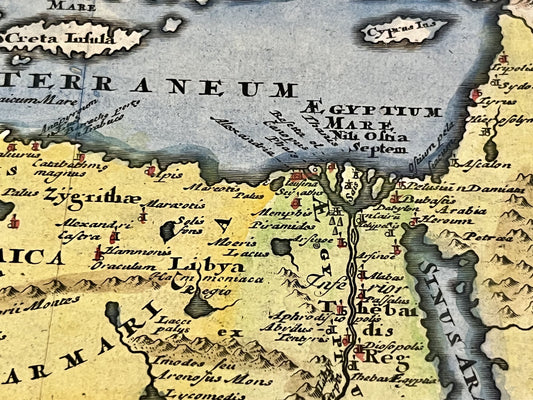
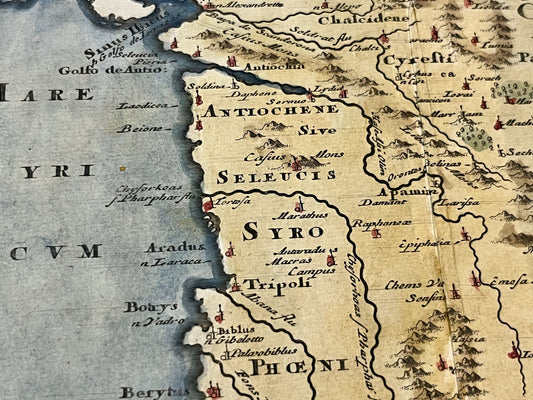
A European scholar and traveler
Philipp Cluwer was born in Danzig in 1580. After studying law in Leiden under Joseph Scaliger, he turned away from a legal career to devote himself to geography. His life was marked by numerous journeys throughout Europe, particularly to England, France, Germany, and Italy.
Settled in Leiden, he received the title of "Geographus Academicus" (Geographer of the Academy). His approach revolutionized the discipline by linking the study of places with that of classical texts and ancient history. He died in Leiden in 1622 at the age of 42.
Foundations of Historical Geography
Philip Cluwer is the author of major works that have served as references for over a century. His work is distinguished by a thorough analysis of ancient literary sources to reconstruct the geography of the past.
His most notable publications include:
- Germania Antiqua (1616), an illustrated work dealing with ancient Germania.
- Ancient Sicily (1619) andAncient Italy(published posthumously in 1624), detailed geographical studies of Sicily and Italy.
- Introduction to Universam Geographiam (1624), a universal manual published after his death, containing many maps and which became a classic in geographical teaching.
Influence and cartographic legacy
Although primarily a study geographer and historian, his work resulted in significant series of maps. His work was widely disseminated and republished by prominent cartographers and publishers such as Petrus Bertius, Jodocus Hondius or even Elzevir.
His style is characterized by a desire for precision in the location of peoples and regions of Antiquity, laying the foundations of the scientific method in historical geography.