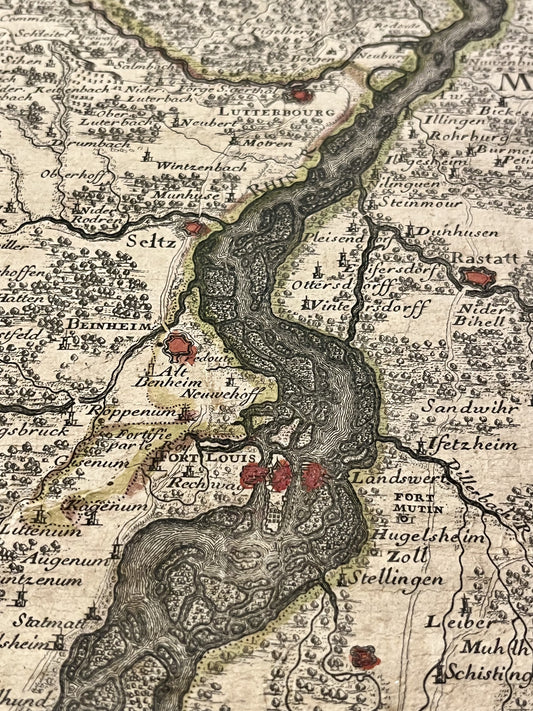
An engineer and geographer in the service of the King
Gaspard Bailleul (also spelled Baillieul or Bailleux) was a French geographer, engraver, publisher, and printer active from the late 17th century until his death in 1744. Based in Paris, he worked primarily from an office located near the Pont au Change. From at least 1735, he held the title of Engineer and Geographer to the King. His technical expertise enabled him to produce a wide variety of documents, ranging from military cartography to ecclesiastical maps.
A diverse cartographic production
Gaspard Bailleul's career is marked by numerous collaborations with the great names of his time, such as Alexis-Hubert Jaillot and Nicolas de Fer.
His notable contributions include:
- The ecclesiastical atlas: He illustrates for Dom Beaunier the "Historical chronological and topographical collection of the archbishops, bishoprics, abbeys and priories of France" (1726) with eighteen geographical maps.
- Regional and global mapsWe owe him specific works such as the "Châtellenie de Lille" (1707) or a "Nouvelle Mappe-Monde" dedicated to Bertrand René Pallu.
- The World and its parts: A major work published in Lyon and Dijon around 1750 (posthumous title) presents the world and its continents.
A family and publishing legacy
Upon his death in 1744, Gaspard Bailleul's business was passed on to his children: François (known as the elder), Marie, and Nicolas (known as the younger). They inherited his expertise, specializing in engraving letters and inscriptions. His son, Nicolas Bailleul, continued the publishing activity in Lyon, publishing several maps in collaboration with the printer Jean-Louis Daudet. Gaspard Bailleul's influence extended well after his death, as his plates were used or adapted by later cartographers such as Georges-Louis Le Rouge.