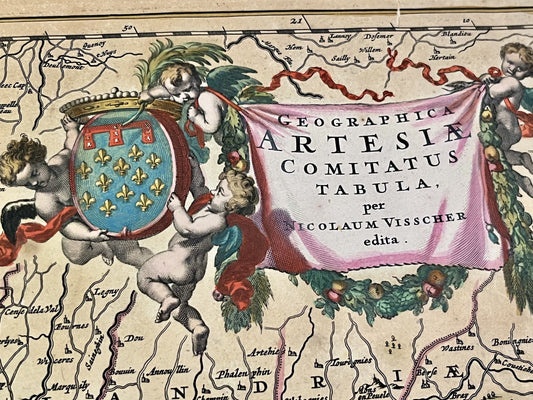
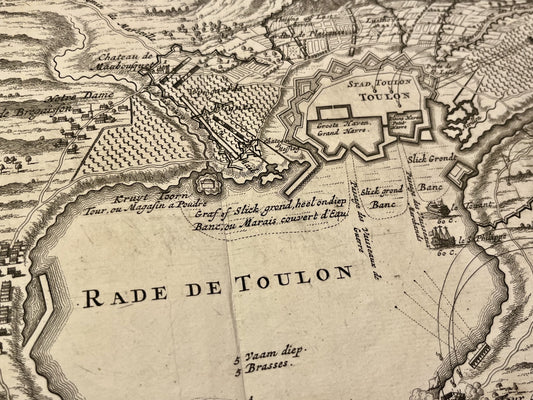
A Dynasty of Cartographers and Engravers
Nicolas Visscher (identified as Nicolas I) was born in Amsterdam on January 25, 1618. He was the son of Claes Jansz Visscher (also known by the Latin name Nicolas Joannes Piscator), a renowned engraver and publisher who was a pupil of Jodocus Hondius. Nicolas I continued his father's work, running one of the most prolific publishing houses of the Dutch Golden Age. His son, Nicolas Visscher II (1649-1702), would succeed him at the head of the family business.
A Distinctive Graphic and Scientific Style
The maps produced by Nicolas Visscher are distinguished by high-quality artistic execution. They frequently feature richly illustrated cartouches depicting characters, animals, or allusions to the family name (a fisherman, "Visscher" meaning fisherman in Dutch). Geographically, he made notable improvements:
- Innovations in Europe: He incorporated the works of Isaac Massa on Russia and the Volga region into his general maps of Europe.
- Geographical Purifications: His publications helped to eliminate persistent errors, such as the fictional island of Frisland in the North Atlantic.
- Political Updates: In 1658, he published a map of Africa including the first Dutch settlement at the Cape of Good Hope (1652).
The Atlas Minor and the Perpetuity of the Visscher Collection
From the 1670s, the family produced composite atlases under the title of Atlas Minor. These works, often without a fixed title page, gathered maps on various themes according to demand. Upon the death of Nicolas Visscher II in 1702, his wife, Elizabeth Verseyl Visscher, took over the management of the workshop until her death in 1726. The business, including the original copper plates, was then bought by the publisher Peter Schenk, ensuring the dissemination of the Visscher dynasty's work long after their own activity.